
October 7, 2026 · 7 min read
Tempered glass vs privacy glass: which one for your iPhone
Both are tempered glass, both go on the same way, and both take the knocks your screen would otherwise take. The difference is who else can read your screen, and that difference follows you all day.
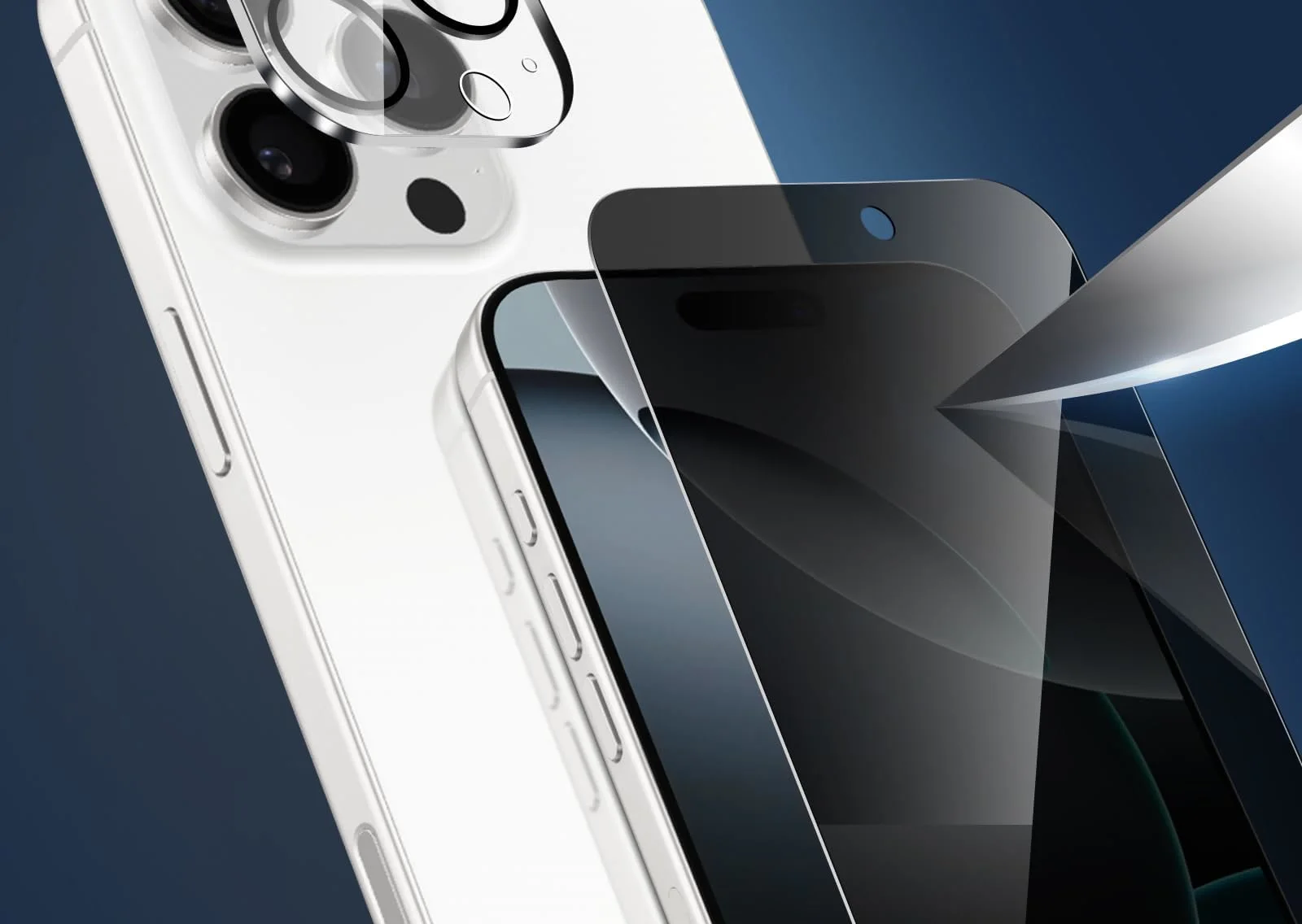
Two kinds of glass, one job underneath
Start with what the two share. A clear screen protector and a privacy screen protector are both sheets of tempered glass that sit on top of your iPhone's display. When the phone hits a step or slides off a table, the glass takes the hit and can crack, so the screen under it does not have to. When keys share a pocket with the phone, the glass collects the scratches. Either kind does that job.
Our clear glass for iPhone 11 to 17 is 0.33 mm thick by the box and comes three to a pack with an alignment frame. Our privacy glass for iPhone 7 to 17 is also three to a pack, with an installation tool, and adds one thing the clear sheet does not have: a filter that narrows the angle from which the screen can be read.
What the privacy filter changes
On most of our privacy glass the box gives that angle as 28 degrees. Hold the phone in front of your face, inside that angle, and the picture reads as usual. Move to the side and the screen goes gradually darker, until a person on the next seat sees a dark panel. Our set for iPhone 14 Pro Max, iPhone 11 Pro Max and iPhone XS Max is rated at 35 degrees, a little wider.
Think of where you read messages. On a commuter train, in a doctor's waiting room or at an airport gate, the people around you sit at your side, and that is exactly where the filter works. At home on your own couch it has nothing to hide from.

What you give up with privacy glass
The filter cannot tell a stranger from a friend. Hand your phone sideways to show a photo, or lay it flat on a café table to watch a clip with someone, and they will see less than you do. You will tilt the screen toward them, or take the phone back and turn it around.
Angles matter for you too. A phone standing in a dock on your desk, glanced at from your chair, may sit outside the 28 degrees. So may a phone on a car mount set off to one side. If you read your screen from odd angles every day, clear glass will feel easier to live with.
Privacy glass also has black edges, while our clear glass for iPhone 11 to 17 has transparent ones. The black border frames the display and makes it plain if the glass sits a hair to one side. Some people like the look, some prefer the phone to look bare.
Side by side
| Clear tempered glass | Privacy glass | |
|---|---|---|
| Who can read the screen | Anyone who can see it | People within about 28 degrees of straight on, 35 on the large Pro Max set |
| Edges | Transparent on the iPhone 11 to 17 glass | Black |
| Fits | iPhone 7 to 17 and iPhone Air across our sets | iPhone 7 to 17 and iPhone Air across our sets |
| Pack | Two or three glasses, many with a frame | Two or three glasses, many with a frame or tool |
| Best for | Sharing the screen, docks and mounts | Commutes, waiting rooms, open offices |
Camera lens covers come with both
If you want the back of the phone covered too, you do not have to choose between privacy and lens protection. Our privacy set for iPhone 13 to 17 and iPhone Air pairs the dark screen glass with camera lens covers and an installation frame. On the iPhone 14 fit, the box holds three privacy glasses, three lens covers and a dust plug for the charging port.
Clear glass has the same option. Our combo for iPhone 13 to 17 puts clear screen glass and camera lens covers in one box, again with a frame, and single-model combos exist for phones such as the iPhone 16 Pro and iPhone 17 Pro Max. The lens covers are cut to each phone's camera layout, so a Pro set and a standard set never share them. The camera lens protector page lists every combo by model.
Living with either glass
Day to day, the two kinds are cleaned the same way. Our glass carries an oil-repellent coating that keeps fingerprints from sticking, so a dry microfiber cloth handles most smudges. Skip window cleaner and rough paper towels: they wear the coating down over time, on glass just as on a bare screen.
Replace either kind once it cracks. A crack is the glass doing its job, and once it has done it, the sheet has earned its retirement. With three glasses to a pack, the next one is already in the drawer.
Face ID with either glass
Apple's advice when Face ID stops working is to remove anything that might cover the TrueDepth camera, such as a smudge, a case or a screen protector. For the iPhone 18 Pro models in particular, Apple lists removing privacy screen protectors among the steps to try. We do not make privacy glass for iPhone 18 Pro. Our privacy sets are cut for iPhone 7 through iPhone 17 and iPhone Air.
Whichever glass you pick, if Face ID hesitates after fitting, wipe the top of the screen and look at the edge of the glass near the front camera. A sheet that sits slightly crooked is the usual reason, and the alignment frame in many of our boxes is there to prevent it.
How to choose in one minute
- You read private messages or bank apps on public transport: privacy glass.
- You show your screen to family or watch videos with someone beside you: clear glass.
- Your phone lives in a dock or a car mount off to the side: clear glass.
- You share an open office and keep work chats open: privacy glass.
- You are not sure: clear glass on the phone, and try privacy glass with the next pack.
Both kinds start from the same question: which iPhone do you have? Check Settings > General > About > Model Name before you order. The iPhone 16 and the iPhone 16 Pro look alike at a glance, and Apple lists their screens at 6.1 and 6.3 inches, so their glass is not shared.
Fitting it, and what comes next
Privacy glass goes on exactly like clear glass. Clean the screen, lift the last specks of dust, line the glass up with the frame and press the center. Our installation guide walks through each step and the fixes for dust and bubbles.
On our iPhone 7 to 17 privacy set the glass stops a little short of the screen edge on every side. That margin is deliberate. It leaves room for the lip of a case, so the case does not push the glass up at the corners. If your case has a tall lip, it is a point in favor of this set.
For the full list of privacy fits, with each set's angle and contents, see the NEW'C privacy screen protectors. The privacy glass guide goes deeper into what the filter hides and what it does not. If you settle on clear glass, start from the iPhone shelf.
If the fits list still leaves you unsure, the contact page reaches everyone at NEW'C, and an answer about your model comes back by email.
